The AI Tools That Stick Are the Ones Someone Runs Every Week
Nearly half of small employers use AI, and few have built it in. What the Fed's numbers show, what gets in the way, and four questions for your next tool.
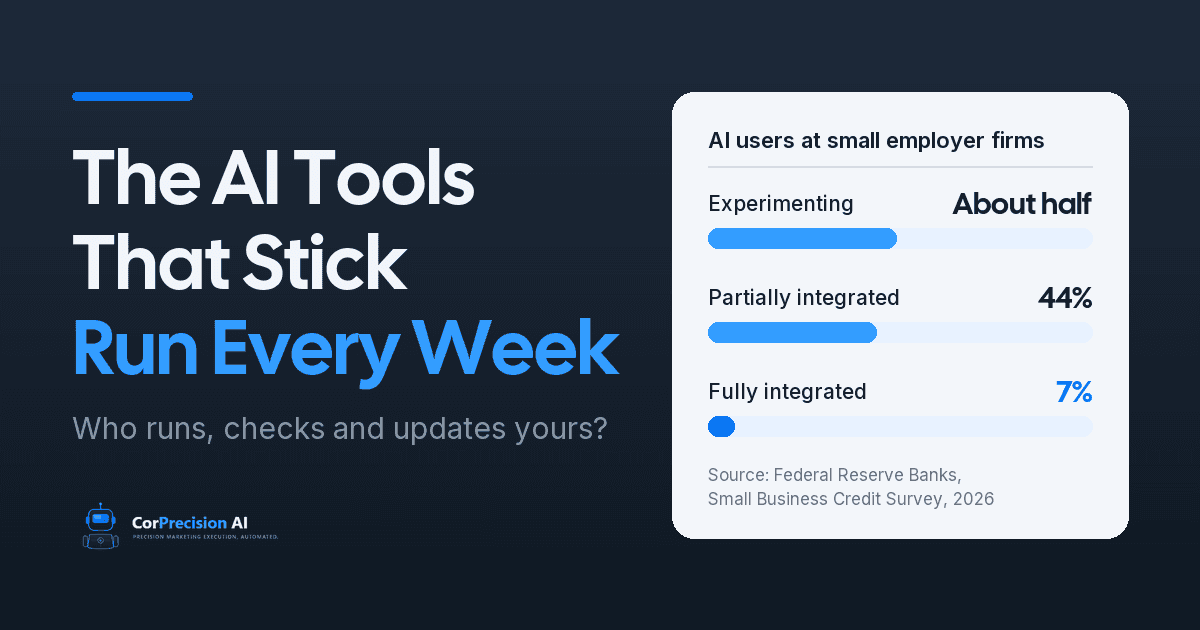
Nearly half of small employers say they or their employees use AI. Far fewer have fully integrated it, and the Federal Reserve has put numbers on the distance between the two. If you are paying for a subscription or two that nobody has opened in a month, that distance is what you are paying for.
Here is how I read those numbers: an AI tool lasts in a business when someone runs it on a schedule, reads what it produces and keeps it fitted to the work. Whoever does that job is a cost of the tool that appears on no pricing page.
Many Owners Use AI, and Few Have Built It In
The cleanest numbers come from the Federal Reserve Banks' Small Business Credit Survey, published in March 2026. It drew 6,525 responses from employer firms with 1 to 499 employees, collected between September and November 2025.
Nearly half of those firms, 46%, said the business or its employees use AI. Among the firms using it, about half described themselves as experimenting, 44% had partially integrated AI into their business processes, and 7% had fully integrated it. Most users report a payoff: 71% said AI increased their productivity. Writing or marketing was the most common use, named by 83% of AI users.
Goldman Sachs found the same shape in a very different group. Babson College surveyed more than 2,400 alumni of the Goldman Sachs 10,000 Small Businesses program in August 2026. In that group, 86% said they use AI in the business, up from 56% in 2024, and 15% of all respondents said AI is fully integrated into their core operations (Fortune, Goldman Sachs). These are owners who went through a business-growth program, so they may be further along than the typical firm. Even so, 77% said they would benefit from more training and resources.
Both samples show the same gap between trying a tool and building it into the way the business runs. Since most AI users put it to work on writing or marketing, I expect much of that gap to show up in marketing: the posts, the emails and the follow-up that the tool was supposed to keep moving.
Of the firms that use AI, 7% say it is fully integrated into the business. About half are still experimenting.
What Gets in the Way Once the Tool Is Bought
The same Fed survey asked AI users about their biggest challenges. The top two were accuracy, named by 46%, and adapting the tools to meet the needs of the business, named by 43%. Firms that were still planning to adopt worried first about finding tools that fit (54%) and about the time it takes to implement them or train people (37%).
I read those two answers as job descriptions. Accuracy is a review job. Someone reads what the tool produced before a customer sees it, every time it produces something. A draft post with a wrong date, an email that promises a service you stopped offering, a follow-up that goes to the wrong list: each of those is caught by a person or it goes out under your name.
Adapting the tool is an upkeep job. Someone updates its instructions when you add a service, change an offer, raise a price or learn that a phrase lands badly with your buyers. The tool knows what it was told on the day it was set up, and the business keeps moving after that day.
Both jobs come back every week the tool runs. In my experience, that is where most tools stall. The purchase happens in a spare hour. The weekly review and the weekly upkeep have to come out of weeks that are already full, and in a business without a marketing staff, those hours belong to the owner. When the owner gets busy, the review slips first, the output stops getting used, and the subscription keeps billing.
Checking accuracy and keeping the fit right are recurring work, and both need a person's time.
The Job Nobody Names: Running It Every Week
Large companies with full marketing departments run into the same wall. The Martech Weekly's Enterprise Martech Outlook 2026, reported by MarTech in October, found that 10.8% of agent initiatives at the enterprises it surveyed are fully scaled in production. Just 1.6% allow fully automated AI-generated content to reach customers. The largest group, 43.3%, lets AI-generated content out the door only after it has been reviewed, edited and verified. The survey covers large organizations and the article gives no sample size, so treat it as a view of a world far from a 20-person company.
These are companies with marketing staffs, budgets and operations teams, and the largest share of them still routes AI output through a human before a customer sees it. At that size, reviewing AI output is a standing part of somebody's job.
A MarTech column published the same week put names on the roles. Melissa Reeve sorts the people around AI systems into four groups: builders, who start things; maintainers, who keep things running; monitors, who watch what the system does; and users, who apply AI to their own work. "In marketing, day two is predictable," she writes, and lists what goes wrong after launch, such as a campaign that ends while its agent keeps running, a model update that throws off the brand voice, or a renamed CRM field that quietly breaks lead routing.
"Each one needs a maintainer or a monitor, and in most organizations, that person isn't named." (Melissa Reeve, MarTech)
In a business without marketing staff, all four roles land on the owner. The owner buys the tool, uses it, and is the only person who would notice when it drifts or breaks. Setting a tool up can take an afternoon. Maintaining and monitoring take some time every week for as long as you pay for the tool, and that is the part that falls off first when the week gets crowded.
Four Questions to Ask Before You Pay for the Next Tool
Buy the next AI tool the way you would fill a recurring job: decide who runs it before you sign up. Four questions do most of the work.
- Does it run on a schedule without you opening it? A tool that waits for you to remember it competes with everything else on your list. A tool that produces its work on a set day, ready for review, keeps moving through a busy week.
- Is the first draft close to usable? If reviewing and fixing the output takes as long as doing the work yourself, the tool saves you nothing, and it will lose that comparison every busy week.
- Who reads the output before it goes out, and on which day? Name the person and the day. If your answer is "me, whenever I get to it," that is probably also the answer for the tools you already stopped opening.
- What will it be doing in week six? By week six the novelty is gone, the business has changed a little, and the instructions written on day one are out of date. Someone has to update them. If you cannot name that person, plan on the tool becoming one more login you pay for.
My own team is built around that idea. The five roles on CorPrecision's digital marketing team (Research, Content, Outreach, Follow-Up and Reporting) run every week, and the owner reviews one pack a week with everything we plan to publish or send. Nothing is published or sent until the owner approves it.
Decide who will run, check and update a tool before you pay for it.
Start With the Tools You Already Pay For
This week, pull up your card statement and list every AI tool the business pays for. Next to each one, answer three questions:
- Did it do work last week that you used?
- Who checked that work before anyone outside the business saw it?
- Who will update it the next time your offer, your services or your prices change?
A tool with a blank in the second or third answer has nobody running it. Give it a named person and a day on the calendar, or cancel it and keep the money. Then put the four questions above in front of the next purchase.
To see what a full marketing week looks like when someone runs it, the Weekly Cadence guide lays out the loop, and the day-by-day walk-through takes it one weekday at a time. To find where your own week breaks down, start with the 30-minute cadence audit. And if you want your digital marketing team running the week while you keep the approvals, the Done-For-You service page explains how that works.